Word2Vec: When Words Acquire Geometry
How prediction turns words into points, neighborhoods and surprisingly useful directions.
What would it mean for a word to have a direction?
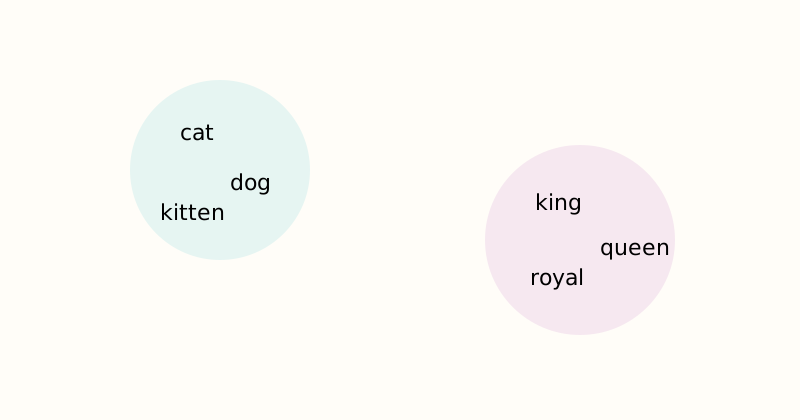
Word2Vec gives each word a vector and learns those vectors from a prediction task. Words occurring in related contexts tend to acquire related representations.
The training trick
In skip-gram, given a centre word, the model predicts surrounding context words. In CBOW, surrounding context predicts the centre.
The remarkable part is that the learned weights become useful representations.
similarity = dot(u, v) / (norm(u) * norm(v))Cosine similarity then turns geometric proximity into a practical semantic lookup.
Directions can carry relations
The famous analogy intuition is
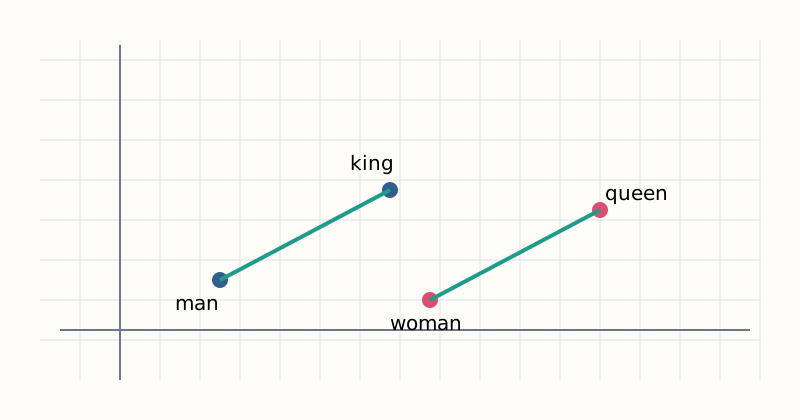
But this is not symbolic logic. Embeddings reflect statistical regularities, corpus choices and biases. The geometry is powerful precisely because it is a compressed model—not reality itself.
That brings us back to George Box: all models are wrong, but some are useful.